The Perfect Evening We Forget by Midnight
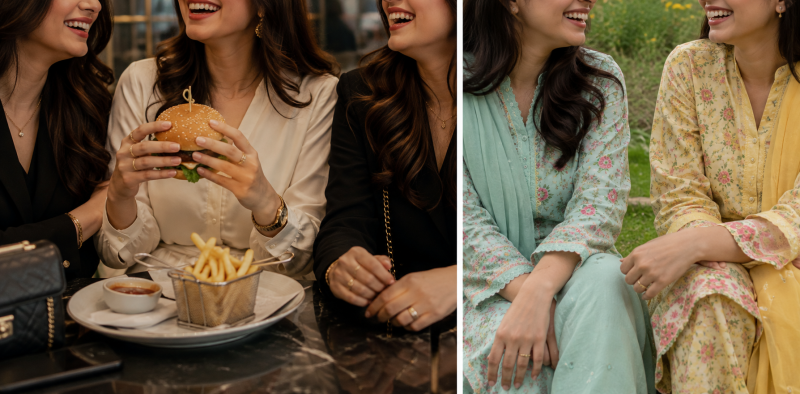
Imagine this: a perfect evening in Islamabad. You wear your evening dress and some red lipstick and go to a joint to eat a burger you’ll forget about six hours later. The next day, or maybe the day after, you want to do it all over again.
Why is it all so forgettable, yet you keep craving it, day after day? Why do you dress up, go to a restaurant, and feel no satisfaction by the end of the evening? Why do you save your Western clothes and your nice perfume for such evenings?
A Plastic Chair and a Weed-Filled Park
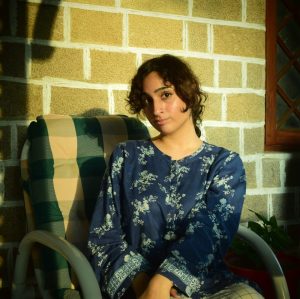
On my sister’s birthday, my parents told us all to dress up. I dressed to the nines and did my makeup well, only to find myself sitting on a plastic chair, at a plastic table, in the outside seating area of a bakery in a not-so-fancy sector, two minutes from my house. I was annoyed, crabby, and a pain in the butt, until I realized I was acting out of the same classism I abhor in other people. My sister (way too cool for me, much funnier than me, and much smarter than me) told me to chill. And I did. And it was fun. It was the kind of evening the repressed teenage me craved: informal and brutish, like the boys you envy who sit at dhabas. Close enough, at least.
It got me thinking: why is our example of a perfect evening a certain way, and why is it always kind of dull, even when we crave it? Is it our collective, semi-old-money distaste for everything visibly middle or lower class? Is it the fact that, as women, we can only wear our perfect jeans and the blouse we spent money on in an upscale area where we won’t be ogled?
On another pre-June afternoon, hot but not the burning kind of heat that stifles your day, my sister and I took a two-minute walk and found one of Islamabad’s many neighbourhood parks. We watched young children play, sweaty in their mismatched clothes, and a group of slightly older girls gossip and smile with uneven teeth. My sister said she envied them. “Why can’t our social class hang out like this? In a weed-encrusted park, in our ragged lawn home clothes? Why can’t we claim public spaces for simple fun?” And it was fun: calm, sweet, and innocent.
In this article I want to explore and try to answer these questions.
A City Built for Cars, Not People
Why, with all the new skyscrapers in New Blue Area, are there no art galleries, museums, arcades, or indoor play areas? Why are these countless buildings filled with forgettable restaurants?
There’s a video that explores why animals don’t have wheels for legs. It concludes that four-legged animals are adapted to the uneven terrain of the earth, while roads were made for wheels. Someone on X joked that if aliens came to earth, they would think cars are the main species and that they eat humans. New Blue Area seems strangely dystopian to me; the buildings look cyberpunk as they loom over Islamabad’s landscape in their industrial neon. CDA’s New Blue Area, introduced in 2020, was planned for office towers, malls, hotels and mixed-use high-rises. The land where it stands was once a multipurpose football, wedding, funeral and sports ground for the families who lived in the G-9 government apartments. Simple fun, simple utility, for a community.
A Grid Without the Civic Spirit
Islamabad was drawn up in the 1960s by the Greek planner Constantinos Doxiadis as a grid of sectors. Mohenjodaro, a city on the banks of the Indus in modern-day Sindh that is more than 4,000 years old, also had an orderly, walled layout, with houses, workshops, markets and wells arranged by zone. Notably, archaeologists have found no grand palaces or royal tombs there, which has led many scholars to suggest a more collective form of civic organisation.
A key phrase here is “collective civic organisation”: the way a community or city is structured or governed, with a focus on shared public responsibilities and services.
So sad that we kept the grid and forgot the collective civic organisation.
It could be argued that this is simply where the money lies, and that this is financial security. But what made our main idea of fun into boring, repetitive gluttony?
The Decline of Reading Culture
It could be a decline in reading culture. The literacy I’m talking about here is different from being educated and knowing English. It’s an interest in literature, culture, history and art. It says a lot that a gem like the Pakistan National Council of the Arts (PNCA) is mostly empty, except when there’s an overpriced family fair where you pay an additional entry fee to see pedigree dogs and cats on top of the fair’s entry fee. I just want to see the cute dogs, man. Why do I have to pay 800 rupees? There’s also the Lok Virsa Heritage Museum and the Natural History Museum, where you don’t even need to pay to see the dinosaur.
The research points the same way, though it comes from elsewhere. In the US, the share of 13-year-olds who read for fun almost every day fell from 27 percent in 2012 to 14 percent in 2023.
Pakistan’s own numbers are low to begin with. Overall literacy stands at 63 percent, the lowest in South Asia, and the official bar is minimal: reading a simple statement and writing a simple sentence. Poverty and child labour keep many children out of classrooms, and in the upper classes, a tough job market and financial insecurity push more people toward business, and business follows the trends: watery iced lattes, syrup-flavoured soda, and bad white-sauce pasta.
I sound so ancient here, but my parents used to give me cool dinosaur encyclopedias as a kid. I admit I never read them, but I looked at the pictures and drawings. Artists made those illustrations that captivated me: whales and dinosaurs and cars and buildings, pop-up sharks and intricate activities within a book. Is the modern equivalent for kids bad phone games and YouTube Shorts? For one thing, they can easily text their friends. I noticed that the more easily accessible my school friends were, the more distant I got from my neighbourhood friends. Are digitalisation and modern urban planning isolating?
Rising Heat, Shrinking Play
It could also be the rising temperatures. According to MeteoBlue, Islamabad’s mean yearly temperature used to be 20°C and is now 23°C. Rainfall has fallen from around 1,100 mm a year to 800 mm. A 30-year climate report records the predicted mean climate of every region, and March in Islamabad used to be about 2°C colder than that prediction; now it is 3.4°C higher.
That’s one reason children don’t play outside anymore. A UK report by the Raising the Nation Play Commission found that time spent playing outdoors has fallen by 50 percent in a generation, and many studies affirm the trend. So what do kids do instead? They’re on their phones and tablets.
Short-Term Gratification and the Burger Cycle
As someone who has successfully gotten a handle on their phone addiction, I’ve noticed that when I watch short-form content, even when it’s educational and hits my topics of interest, even when it’s my friends’ stories and posts, even when I’m mindlessly picking up my phone to check for messages and notifications, the rush of dopamine from a notification leaves me less satisfied by the simple things I enjoy. Suddenly, reading, or having a breakfast I made myself and arranged on a pretty plate, something that usually makes me look forward to waking up, just doesn’t satisfy. I want more. I end up scrolling the food delivery app. I end up not enjoying the act of reading. I end up hating everything I write or paint. Nothing is enough.
Those are the classic signs that I’ve gotten used to short-term gratification again. I go to bad burger joints, and the cycle repeats.
Women and the Right to Public Space
But where do I wear my cute clothes, my jeans, stuff that isn’t a plain shalwar kameez? Not in the area I live in; I could wear a burqa there and people would still stare. Are restaurants and cafes in upscale areas, where other girls are glammed up and giggling, the only places women have claimed as comfortable? Here, an environmental factor plays in. The outside in Pakistan is a man’s world, and it’s usually uncomfortable for a woman to be in certain places, especially after sundown. There’s no statistic or study I can find, but women are usually terrified of being alone in public once it’s dark.
Women do not have a claim to public spaces. Women do not have a claim to public safety. It takes a very impressive woman to occupy space as a man does, and even then, only certain spaces at certain times. Because women are so easily cornered, or character-assassinated for being in the wrong place at the wrong time, they have to go to places deemed appropriate. For me and the women around me, those are the places the general public goes to, the places that set the trend and give the act of going out and existing as a woman a sense of propriety. And so the cycle of trend goes, in a place like Pakistan.
The Vicious Cycle
Pakistan had a boom in art and literature in the 1970s. After that, well, here we are.
Long ago, work days were short enough for parents to spend time with their children: to guide them, teach them, bond and connect. Now the kids don’t read books and don’t stop watching short-form content, and the adults are barely making ends meet on ten-hour days, getting together only to eat bad food at overpriced restaurants.
And so it goes, like a self-consuming ouroboros, a vicious cycle beyond our own puny circle of control.
References
New Blue Area Islamabad guide (Milkiyat)
Constantinos Doxiadis (Wikipedia)
Federal Data on Reading for Pleasure (NEA)