

ISLAMABAD: Pakistan has raised concerns over the recent India-Canada nuclear agreement, which includes a long-term uranium supply deal and cooperation on advanced reactor technology. Officials say the development could have serious implications for regional stability.
The India-Canada agreement was announced after a meeting between the prime ministers of both countries in New Delhi. The leaders discussed strengthening ties following a period of diplomatic tension. During the meeting, the two sides finalized a 10-year nuclear cooperation plan.
As part of the deal, Canada will supply uranium to India under an agreement valued at around $1.9 billion. The India-Canada partnership also includes discussions on collaboration in small modular reactors and other advanced nuclear technologies.
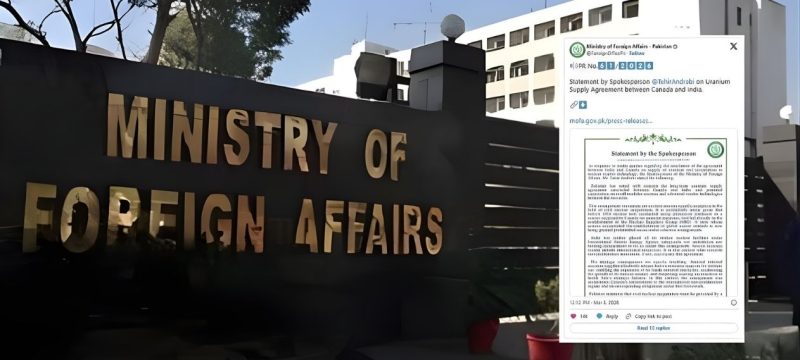
Responding to media questions, Pakistan’s Foreign Office spokesperson Tahir Andrabi said the agreement raised several concerns. He noted that India’s 1974 nuclear test played a key role in the creation of global export control mechanisms.
According to Andrabi, the test used plutonium produced in a reactor that Canada had supplied earlier for peaceful purposes. This incident later led to the establishment of the Nuclear Suppliers Group (NSG), which regulates nuclear trade worldwide.
The spokesperson said it was ironic that a country linked to the creation of strict export controls is now receiving special arrangements for nuclear cooperation.
He also pointed out that India has not placed all of its civilian nuclear facilities under the safeguards of the International Atomic Energy Agency. Some facilities remain outside international inspection.
Pakistan also questioned whether the India-Canada agreement includes strong commitments related to nuclear non-proliferation. Officials said the details of such assurances remain unclear.
The Foreign Office warned that stable uranium supplies from abroad could allow India to use its own uranium reserves for military purposes. This, officials argue, could increase the production of fissile material and expand India’s nuclear arsenal.
Pakistan believes this situation may widen the strategic imbalance in South Asia. Authorities also stated that such agreements could weaken global non-proliferation efforts.
The spokesperson stressed that civil nuclear cooperation should follow a fair and non-discriminatory approach. He said such arrangements should apply equally to all states that are not members of the Nuclear Non-Proliferation Treaty.
In other news read more about Canada declares India’s Bishnoi Gang a Terrorist Entity
Pakistan maintains that selective exceptions in nuclear cooperation could harm the credibility of international non-proliferation systems and create risks for regional and global security.