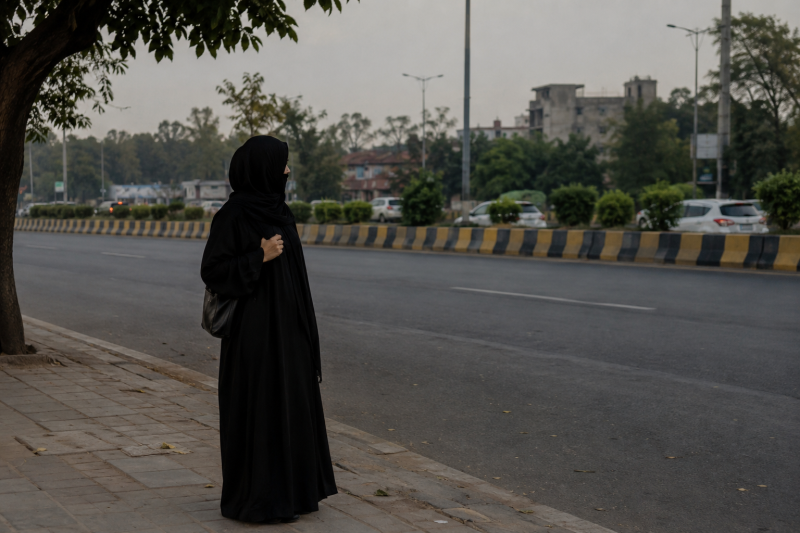
I was waiting at an electric bus stop on a main road in Islamabad, with residential houses on both sides. I had done some makeup because I had to go somewhere later that day, and I was wearing an abaya over my jeans and T-shirt. A white SUV with a young man inside slowed down, and he gestured for me to come in. I gestured back for him to leave. At the bus stop there were many smaller cars that were probably government taxis or cars registered on ride-hailing apps. But this had never happened to me before, so I called my brother to ask whether what I thought was true. He confirmed that yes, the man in the car thought I was a prostitute.
What Does Modesty Mean When an Abaya Isn’t Enough?
I protested that I was wearing an abaya with a dupatta. He said that all the prostitutes on Murree Road dress this way. My feminist self was raised by very religious parents, so I was shocked but not surprised. When I came home and took off my abaya, my mother expressed disappointment at my Western clothes.
Why Does Patriarchy Keep Redefining “Whore” to Fit Every Woman?
Patriarchy will always change the definition of a whore to fit every woman. Everybody has their own definition of a prostitute: the woman with her hair out, the unmarried woman, women who live alone, women who wear red lipstick, women who dress Western, women who work. Whore just means woman.
When you step out of these delicate bounds that even you cannot traverse, you will be inviting stares, sexual assault and rape. The men in your family will tell you to cover up because they are protecting you; it is their right and duty to make you cover up. And when you do, other men will think you are a prostitute.
Do Women in Pakistan Feel Safer in an Abaya?
I have nothing against prostitutes, only against the flimsiness of our culture’s definition of modesty. I presume prostitutes, too, need the abaya as a form of safety when they are moonlighting. Prostitutes, too, might feel safer in riskier situations wearing an abaya. Even as a feminist, I feel (felt?) safer roaming around my own middle-class community in an abaya. I’m sure they, too, have been told by their parents that if we’re not covered up, it’s our fault we are stared at. I suppose they, too, have been told, “Ghar khulla choro gi tau kyun na log andar ayen.”
In a country where 4,446 rape cases and 940 gang-rape cases occurred within the province of Punjab alone during the first six months of the year, in a country where the first thing your own family along with the public asks, “What were you wearing?” In a country where an abaya, a dupatta, staying at home at night is reported to guaranteed safety, I suppose both prostitutes and I, along with a million girls in Pakistan, feel safer in an abaya.