Why Does Pakistan Call Gender Non-Conformity “Western”?
If you are a woman in Pakistan and you turn down a rishta, put off having children, or take a job that keeps you out past maghrib, sooner or later someone will tell you that you have become “Westernized.” It is usually said lightly, sometimes with a sigh, and it almost never needs explaining. Everyone in the room knows what it means: you have stopped behaving the way a good daughter, wife or sister is supposed to.
The word does a lot of work for a lot of people. It lets a family end a conversation without having it, and it lets a television host dismiss an entire movement in one breath. What it rarely does is describe anything that is actually foreign.
How Do Public and Private Roles Shape the “Western” Label?
Underneath the label sits an old division of labour. Men earn and deal with the outside world. Women run the house and look after children, the elderly and the sick. Plenty of families live this way and are content with it. But the arrangement is treated less like a family decision and more like a moral order, so a woman who wants her own income, or simply isn’t ready to marry, gets read as someone importing individualism into a culture built on family.
The numbers show how firmly that order still holds. In Pakistan’s 2024-25 Labour Force Survey, women’s labour force participation came in at 24.4%, up from 21.4% four years earlier. Among women outside the labour market, 56% say domestic responsibilities are the main reason. That is not a population swept away by Western individualism. It is a population doing most of the country’s unpaid work.
What Role Does Haya Play in the Backlash?
Haya, usually translated as modesty, is central to how many Pakistanis think about gender. It covers how you dress, how you speak, who you sit beside and what you post. Many people hold it as a sincere personal value, and there is nothing foreign about that. The trouble starts when it becomes a measuring tape for other people’s lives.
You can see it in how a woman’s ordinary choices get discussed. A job, a late return home, a post on social media: each becomes a question about her character instead of her own business. Objecting to a particular decision is one thing. Treating every departure from the script as proof of foreign influence is another.
Is “Western Agenda” a Political Strategy?
Anti-Western feeling in Pakistan has real roots: colonial rule, decades of foreign policy decisions, aid with strings attached. That history is exactly why the accusation sticks. Call a movement foreign-funded and you no longer have to answer what it is asking for.
An analysis from the US Institute of Peace argues that this criticism rests on a simplistic divide that treats feminism and Islam as opposites, and suggests that women’s rights movements will stay polarising until they engage with progressive religious voices. You don’t have to agree with every slogan to see the problem with a charge that works as a conversation-stopper.
Is Economic Necessity Changing Gender Roles in Pakistan?
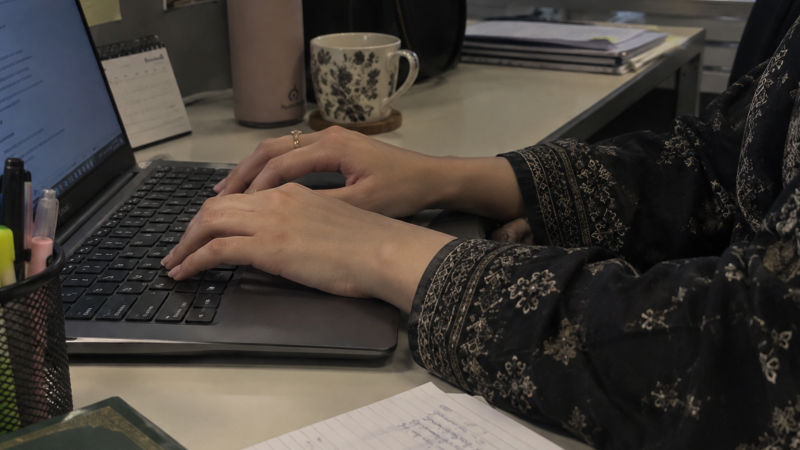
This is where the “Western” label really falls apart. AFP reported on urban households where inflation pushed women into work for the first time. What is the point of education if a girl can’t be independent?
The picture is more mixed than the phrase “dual-income household” suggests. Business journalists pointed out in 2025 that the typical multi-earner household in Pakistan is still made up of two related men, such as a father and son or two brothers, rather than a husband and wife.
Then there is the oddest statistic of all. In the World Economic Forum’s 2026 Global Gender Gap Report, Pakistan ranked 143rd out of 145 economies overall, yet first in the world for parity in tertiary enrolment, with 10.71% of women and 11.01% of men enrolled. On economic participation, it ranked 144th. (The WEF’s 2025 edition cautioned that part of the education gain came from fewer men enrolling, not only more women.) Women are sitting in lecture halls at close to equal rates and then mostly not entering paid work. If Westernization were the engine, you would expect careers to follow degrees. They largely don’t.
Do Pakistanis Need the West to Justify Women’s Rights?
The more useful question is whether women’s independence needs a Western origin story at all. Khadijah bint Khuwaylid, the Prophet’s first wife, ran a successful trading business and, according to Islamic tradition, hired the young Muhammad to help with her trade. Fatima al-Fihri is credited with founding the University of al-Qarawiyyin in Fez in the ninth century, often described as the world’s oldest university. People can argue about how these examples apply today, and conservative scholars read the same sources differently. But nobody can seriously call them imports from Europe.
What About Men Who Step Outside Traditional Roles?
Men are not exempt. A man who cooks, stays home with the kids, or picks a career his relatives don’t consider serious gets his own version of the same commentary. The word isn’t “Westernized” for him. It’s closer to joru ka ghulam. Urban circles have grown a little more relaxed about this, but the underlying message is the same one women hear: stay inside the lines, or people will talk.
What Does the “Western” Label Really Tell Us?
Mostly it tells us that a real argument is being avoided. The real questions are local ones. How much freedom should an adult have inside a family? Who decides whether a woman works, marries or travels? Why do women fill universities and then vanish from the workforce? Wages, safety, education and rights are Pakistani problems with Pakistani answers.
The pressure that is changing gender roles right now is not coming from abroad. It comes from rent, school fees, a daughter’s degree and a mother who would like to be asked what she thinks. Calling that “Western” doesn’t make it go away. It only makes the conversation harder to have.
Sources
Women, work and the gender gap
- Report shows Pakistan’s unemployed population surged by 1.4m in 4 years (Dawn via Asia News Network, 27 Nov 2025): female labour force participation rose from 21.4% to 24.4% in the 2024-25 Labour Force Survey.
- Pakistan Bureau of Statistics launches Labour Force Survey 2024-25 (PID, 25 Nov 2025)
- Pakistan’s missing millions (The News): 56% of women outside the labour force cite domestic responsibilities.
- The stalled arrival of working women in Pakistan (Farooq Tirmizi, Profit, 28 Jul 2025)
- Pakistan’s economic crisis drives women into workforce (AFP via Profit)
World Economic Forum Global Gender Gap Report
- Pakistan at 143rd on gender parity (The Express Tribune, 2026)
- Pakistan ranked third-to-last in WEF’s Global Gender Gap Report 2026 (Asia News Network): 144th on economic participation; first globally on tertiary enrolment parity.
- Pakistan ranks last among 148 nations in WEF global gender gap index (Arab News, 2025): the caution about male enrolment.
The “Western agenda” accusation
Women in early Islamic history