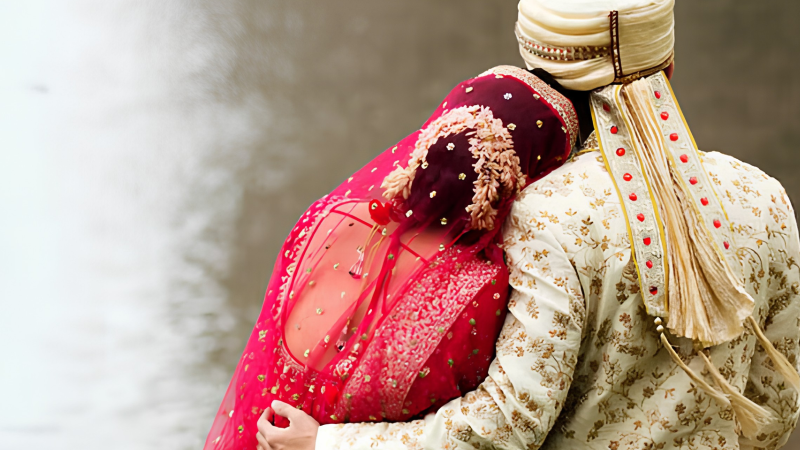
Marriage in a developed country can look like finding your one true love — someone you’re attracted to, someone who makes you laugh, someone financially secure enough to build a life with. Western marriage largely rests on the circumstances of the two individuals involved.
Arranged marriage in a developing country like Pakistan is a lot more complicated. Poverty touches every layer of the social structure, caste attitudes still echo the country’s pre-Partition past, and religious idealization of the Arab world adds another layer on top. Love ends up the last priority in a marital match — sometimes very far down the list.
Marriage as Economic Survival
The institution of desi marriage is shaped, constrained, and in many ways controlled by poverty and economic scarcity. A son is raised as an addition to household income; a daughter is raised as someone else’s future family member. In a structure that denies women financial independence, marriage becomes the mechanism that ensures she’s financially provided for — which makes it, at its core, an economic decision.
In deeply impoverished households, a daughter can be viewed as an economic liability. Marrying her off early transfers the cost of feeding, clothing, and housing her to another family. When resources are scarce, marriage choices get driven by a calculation of material survival rather than emotional compatibility — a family weighing the “cost” of feeding a daughter against the “benefit” of an alliance that offers protection or stability.
Wealthier families use arranged marriage to consolidate capital. Poorer families use it as a survival mechanism to offload economic burden. Either way, the joint family system functions as a direct response to poverty — marriages arranged not to unite two individuals, but to recruit new members into a shared labor and survival unit.
Why Families Marry Within Caste
Marrying within the family or caste (biradri) follows the same economic logic. It keeps resources, property, and dowries from being divided or handed to outsiders — which is also why cousin marriage remains so common: it keeps land consolidated rather than fragmented across families.
Caste in a “Casteless” Religion
Pakistan’s view of caste is shaped by roughly a thousand years of Muslims living alongside Hindu caste-based society, dating back to the earliest Muslim presence in the region. Islam teaches the spiritual equality of all believers — but sociologists point out that centuries of proximity to the Hindu Varna and Jati framework created a distinct social synthesis, sometimes described as a “quasi-caste” system within South Asian Islam.
Most Muslims in South Asia descend from local populations who converted to Islam over generations. Conversion changed their faith, not their economic reality or trade — so birth-ascribed social groupings carried straight into the new religion. A low-caste Hindu weaver became a Muslim weaver, keeping the same social status and occupational circle. The result is a worldview split into two spheres: inside the mosque, all believers are equal; outside it, lineage (zat or quom) still quietly governs who marries whom.
Trust Without a Safety Net
Underneath the sociology, the economics, and the history, this fundamentally comes down to trust. In a country with no reliable unemployment benefits, no universal healthcare, and no institutional safety net, caste (biradri or zat) becomes the currency of trust.
A family that’s economically vulnerable can’t afford to gamble on an outsider. Marrying within caste means dealing with people operating under the same unwritten social contract — if a son-in-law falls on hard times, the biradri network feels obligated to help him find work or keep the family afloat. Marrying within caste is, in effect, an insurance policy.
Love Marriage Is Halal. It’s Still Taboo.
Here’s the paradox: in Islam, a love marriage across social lines is entirely halal. In South Asia, it still triggers deep communal guilt and shame — an ancestral echo of the Hindu fear of Varna-Sankara (the “pollution” of caste lines), rebranded today as family honor, or ghairat.
The Dowry Nobody Admits Is Hindu
The belief that a daughter is a “financial liability” requiring a payout (dowry) to be married off traces directly back to historical Hindu inheritance law, under which daughters traditionally received no share of land. Dowry was never sanctioned by Islam — the Quran makes no mention of it — but South Asian Muslims absorbed the practice from Hindu custom anyway, rebranding it jahez. The anxious, transactional nature of the modern jahez system is essentially a borrowed workaround for a Hindu inheritance rule Islam never had in the first place.
Borrowing Saudi Prestige for Desi Survival
Add one more layer: Arab tribalism. South Asians historically practiced cousin marriage to keep land consolidated under economic strain. Saudi Arabia has its own deeply entrenched structure of tribal endogamy and first-cousin marriage — studies put national consanguineous marriage rates at roughly 50% to 58%, with first-cousin marriages alone accounting for close to a third of all unions. This gives a poor Pakistani or Indian family a new way to frame their cousin-marriage habits — not as a defensive, insular economic survival tactic, but as a prestigious, “purely Islamic” prophetic tradition.
But the mirror only works one way. Saudi Arabia’s own religious tradition treats marrying divorcees or widows as entirely normal. Desi culture, by contrast, inherited the Hindu stigma around widow and divorcee remarriage — so an unmarried Desi man marrying a divorced woman is still viewed as a desperate compromise, even while cousin marriage gets dressed up as prophetic virtue.
The Bottom Line
Strip away the sociology and the theology, and the pattern holds: arranged marriage in Pakistan isn’t really a religious tradition or a cultural preference. It’s an economic strategy — for consolidating capital, for offloading liability, for insuring against a state that offers no safety net at all. Love was never really competing for the top of that list.
Sources: Britannica, Islamic Caste | Wikipedia, Caste System Among South Asian Muslims | Dawn, “Dowry Is Not Islamic” | PMC, Consanguineous Marriage in Saudi Arabia