

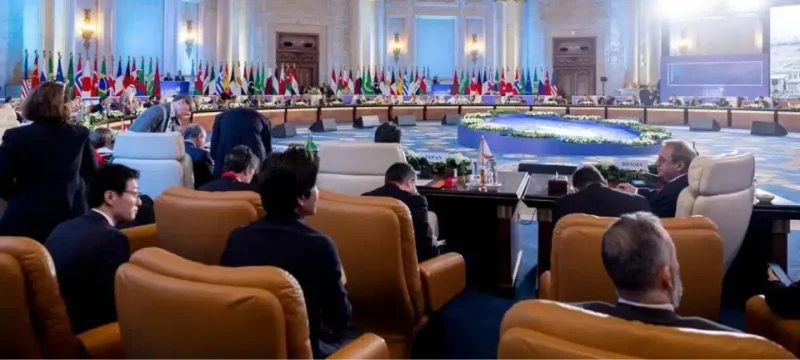
In Cairo, leaders at a summit on Saturday denounced the Israeli bombardment of Gaza. European leaders emphasized the need to protect civilians, but the absence of Israel and senior U.S. officials prevented the meeting from reaching a consensus on containing the violence.
Egypt, the host of the summit, had hoped for a call for peace and renewed efforts to address the long-standing Palestinian quest for statehood. Unfortunately, the summit concluded without leaders and foreign ministers agreeing on a joint statement, despite the ongoing conflict that has led to a humanitarian crisis in Gaza.
Diplomats attending the talks were not optimistic about achieving a breakthrough, as Israel was preparing for a ground invasion of Gaza to target the Palestinian group Hamas. The conflict had resulted in a significant loss of life, with thousands of casualties.
Also Read: Ishaq Dar Calls for Senate Meeting to Discuss Gaza Crisis
While Arab and Muslim states called for an immediate end to Israel’s offensive, Western countries primarily focused on more modest goals, such as providing humanitarian relief to civilians. Jordan’s King Abdullah expressed frustration with the global silence regarding Israel’s attacks and called for a more even-handed approach to the Israeli-Palestinian conflict.
Palestinian President Mahmoud Abbas reaffirmed the determination of Palestinians to remain on their land. Several European countries called for a humanitarian corridor into Gaza to facilitate a ceasefire, while others urged restraint by Israel’s military to avoid further escalation.
The United States, Israel’s closest ally, sent only its Cairo charge d’affaires to the meeting and did not address the gathering in public. The European Council President, Charles Michel, emphasized the importance of listening to each other and working together on various issues, including the humanitarian situation and the peace process between the Israelis and Palestinians.
The summit aimed to explore ways to prevent a broader regional conflict, but achieving public agreement was challenging due to sensitivities around issues such as a ceasefire, Hamas’s attack, and Israel’s right to defend itself.
Leaders in the Arab world were concerned that the Israeli offensive could lead to the permanent displacement of Gaza residents, possibly into neighboring states, as has occurred in the past. Egyptian President Abdel Fattah al-Sisi opposed the displacement of Palestinians into Egypt’s Sinai region and advocated for an independent Palestinian state as the solution. Jordan also expressed concerns about forced displacement and its implications under international law.
Humanitarian aid began entering Gaza through the Rafah crossing shortly before the summit’s opening, as Egypt sought to provide relief to Gaza residents via the only access point not controlled by Israel.